The Royal Lineage · c. 1307 – Present
From Njanya to King Buyelekhaya.
Historical research identifies Zwide as the point where ancestor-praises (unqulo) for Ntu-speaking nations often end. The Thembu lineage through the Great House is traceable from there across more than 700 years.
Foundational ancestor shared by the Mpondo, Thembu, and Xhosa nations.
Source: PDF pp. 1 [5–7]
First-born of Njanya. The Thembu are considered senior to the Xhosa because they descend from this senior line.
Source: PDF pp. 1 [8–9]
His death triggered a succession crisis between sons Zima and Ntande.
Source: PDF pp. 1 [5, 9]
The rightful heir of the Great House. His uncles fought to secure his throne from his older brother Zima.
Source: PDF pp. 1 [9]
His grave at the Msana River marks the earliest traceable burial site in central Thembuland.
Source: PDF pp. 1 [10, 11]
Brothers who split the nation. The AmaDlomo became the ruling Great House; Hlanga's descendants became the AmaQiya.
Source: PDF pp. 1 [10, 12, 13]
His grave marks the continued expansion of the Thembu in central Thembuland.
Source: PDF pp. 1 [12, 14]
Source: PDF pp. 1 [12, 14]
Source: PDF pp. 1 [12, 14]
Paramount Chief during the early 19th-century frontier conflicts. He raised the heir Mtirara.
Source: PDF pp. 1 [15, 16]
Son of Ngubengcuka, raised by the regent Queen Nonesi at Rhodana. His establishment of the Great Place at Rhodana in 1841 brought the Thembu into direct alliance with the AmaQithi San.
Source: PDF pp. 1 [16]
Son of Mtirara, ruled during late 19th-century colonial expansion.
Source: PDF pp. 1 [16]
His reign marked the transition into the modern administrative era.
Source: PDF pp. 1 [17, 18]
A popular monarch who opposed the apartheid-era Bantustan system. He was deposed and died in exile.
Source: PDF pp. 1 [18, 23, 24]
Proclaimed heir in 1987 and officially appointed in 1992, after a period under the houses of Bambilanga and Zondwa.
Source: PDF pp. 1 [25–27]
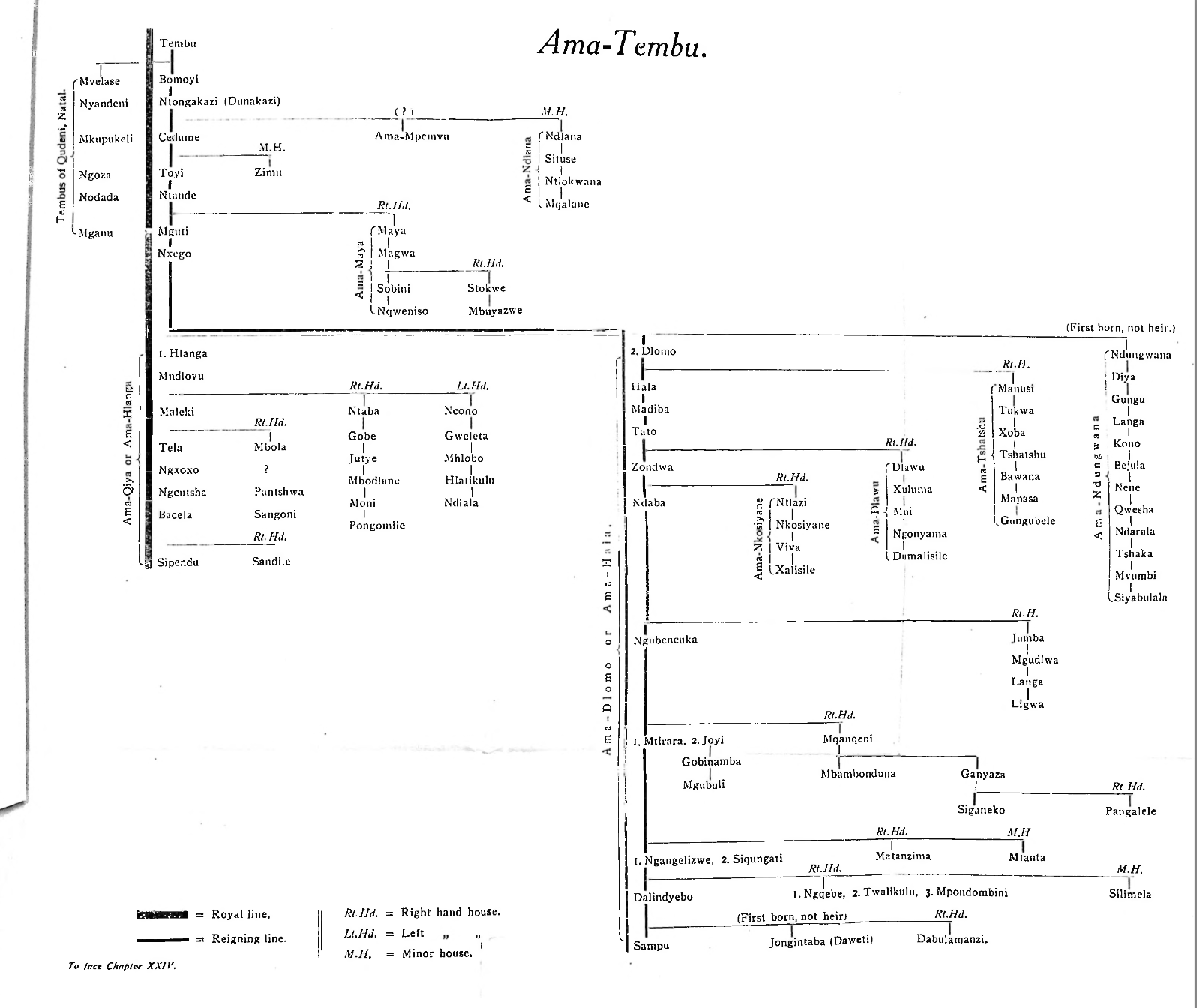
Ama-Tembu royal genealogy from colonial-era records. The full lineage traces from Njanya (c. 1307) through Ntande, Nxego, Dlomo, Ngubengcuka and Mtirara to the modern era.
The San-Thembu Matrix
How the Thembu became who they are.
The abaThembu are historically a creolised population — formed by the fusion of immigrant Nguni groups and indigenous San communities. This is not contested: it is recorded in their praise names, their ritual practices, and the name by which outsiders knew them.
The "Tambookie" Matrix
The name "Tambookie" is a colonial version of the Khoisan term Tam'bou'ci — used to describe the mixed San-Thembu groups living along the Tsomo and Kei rivers. The Thembu were historically a creolised population formed by the fusion of immigrant Nguni groups and indigenous San communities.
The Royal Lineage and San Heritage of the abaThembu, PDF pp. 2 [28, 30, 31]
Praise of the Tiny Man
One of the official traditional praises (iziduko) of the Thembu is "the tiny man" — a direct linguistic acknowledgment of their ancestral San integration, embedded permanently in oral culture.
update1.md §2 (AmaQithi Research Archive, 2026)
The Ingqithi Ritual
The Thembu adopted the San custom of amputating the first joint of the little finger (ingqithi) as a tribal marker. This shared ritual is described in historical records as definitive proof of the "friendly amalgamation" between the two peoples. Other major Nguni groups do not practice this.
The Royal Lineage and San Heritage of the abaThembu, PDF pp. 2 [32–34]; also 28/396, 388
Respect for San Precedence
Early Thembu chiefs gave San hunters precedence over themselves at large game kills, recognising the San as the original owners of the land — a protocol that encoded the equality of the alliance.
The Royal Lineage and San Heritage of the abaThembu, PDF pp. 2 [32, 34, 35]
San Chiefs in Thembu Territory
Leaders like Madolo (Madoor) and Madakane managed territories at the White Kei confluence, interacting with Thembu leaders like Jumba to form multi-ethnic sanctuaries — including the Bushman School established in 1842.
The Royal Lineage and San Heritage of the abaThembu, PDF pp. 2 [23, 28/399, 110, 390]
Migration · The Lesotho Homelands
The Thembu in Lesotho — a return, not a flight.
Between 1600 and 1650, a line of the Thembu under Chief Mngutileft the Lesotho territories, moving toward Herschel in the Eastern Cape and establishing a path toward eNgcobo. This ancient movement established the Thembu's deep historical roots in the mountain territories long before the colonial era.
When the Mfecane wars (c. 1816–1835) erupted due to Shaka's Zulu expansions, Thembu communities who fled northward were returning to ancient homelands, not entering foreign territory. They sought refuge in the high valleys of Quthing— a name combining an ancient San click root (Q-) and a Sotho locative suffix (-ing, “place of”).
In Quthing, the returning Thembu integrated with the local Baphuthi and remaining mountain San networks under the protection of King Moorosi. This highland sanctuary sheltered the alliance until the catastrophic fall of Mount Moorosi on 20 November 1879.
After the fall, the AmaQithi and their Thembu compatriots dispersed across eNgcobo, Cofimvaba, and the secluded valley of Mkapusi in Lady Frere — where they founded Mqithi Village (also known as Mawhumawhu).
Source: The Archive of AmaQithi (update1.md), §§ 3–4 (AmaQithi Research Archive, 2026)
AmaQithi Insights — AbaThembu Geography
Why the same village names appear everywhere.
Komkhulu. Elalini. Emthonjeni. Ngaphezulu. We mapped 278+ GPS coordinates across Thembu country and found something remarkable: every Thembu village cluster follows the same hidden grammar — a blueprint written in place-names. The Komkhulu anchors authority. The Elalini holds the households. The spring gets named. The pass gets named. The field gets named.
And yes — Qithi is one of those recurring names. It means a cleared agricultural patch. It appears in Sakhisizwe, in Intsika Yethu, in OR Tambo. In eight separate locations we can point to on a map.
Read: The Anatomy of a Thembu VillageThe Thembu lineage is your lineage. Come find your place in it.
AmaQithi are Thembu and San. Join the clan register and connect with your extended family.